IEC Standard vs. FM 4478: Is Your Solar Roof Truly Hurricane-Resistant?
In the procurement and engineering evaluation of Commercial and Industrial (C&I) solar photovoltaic (PV) systems, decision-makers frequently analyze compliance frameworks to mitigate financial and operational risks. Two of the most commonly discussed reference systems are IEC 61215 and FM 4478.
Rather than competing certifications, these two standards serve distinct technical purposes. Understanding their alignment, scopes, and specific testing prerequisites is essential for facility managers, EPC contractors, and asset owners evaluating high-value investments.
1. IEC 61215: PV Module Design Qualification and Type Approval
IEC 61215 is one of the foundational international standards for terrestrial photovoltaic (PV) modules. It is important to clarify that IEC 61215 itself is not a certification certificate, but rather a technical design qualification and reliability testing standard.
Certification Mechanism
Under IEC 61215, PV modules are subjected to a sequence of accelerated environmental and mechanical stress tests intended to simulate long-term outdoor exposure. These tests commonly include:
Damp Heat & Thermal Cycling
Humidity Freeze & UV Preconditioning
Mechanical Load & Hail Impact
Other reliability-related stress evaluations.
When a module design successfully passes the required testing program, independent third-party certification bodies (such as TÜV Rheinland or UL Solutions) may issue a Type Approval Certificate or Certificate of Conformity based on the IEC 61215 standard requirements.
Scope and Technical Purpose
IEC 61215 primarily evaluates the PV module itself as an individual product rather than the complete roof-mounted installation system. The standard focuses on validating that the module design can withstand prolonged outdoor environmental exposure without premature:
Electrical degradation or insulation failure.
Moisture-related damage or mechanical structural failure.
⚠️ Technical Note: IEC 61215 qualification should not be interpreted as a quantified lifetime guarantee. The standard demonstrates design robustness under accelerated stress conditions, but it does not directly certify a specific operational lifespan such as 25 or 30 years.
Electrical Performance Evaluation
IEC 61215 also incorporates electrical characterization and performance verification under Standard Test Conditions (STC). The testing framework includes measurements related to output power, current-voltage behavior, insulation integrity, and performance consistency under varying environmental conditions.
Certain editions and associated testing methodologies additionally support performance characterization across varying irradiance and temperature conditions, although the primary emphasis of IEC 61215 remains long-term reliability qualification rather than energy yield modeling.
2. FM 4478: Structural Property Protection and Loss Prevention
FM 4478 is an examination and approval standard administered by FM Approvals, part of the FM Global system. Unlike standards focused primarily on PV module electrical qualification, FM 4478 is fundamentally rooted in the philosophy of property loss prevention and building risk mitigation.
Relationship to Electrical Qualification Standards
FM 4478 does not replace electrical performance or module qualification standards such as IEC 61215 or IEC 61730. In industry practice, manufacturers pursuing FM 4478 approval are generally expected to provide evidence that the PV modules involved have already passed recognized baseline electrical and reliability qualification standards.
FM 4478 itself does not primarily re-evaluate module electrical performance. Instead, it builds upon those previously validated foundations and focuses on structural, fire, and system-level resilience.
Mandatory System-Level Requirements
To obtain FM Approval under FM 4478, the installed assembly must satisfy minimum performance requirements in several critical areas, including:
Wind Uplift Resistance
Hail Damage Resistance
Fire Performance / Fire Spread Resistance Above the Roof Deck
Additional evaluations may also include structural loading and related environmental resilience considerations depending on the assembly configuration.
The “System Certification” Concept
A defining characteristic of FM 4478 is that it evaluates the PV installation as a complete integrated roofing system rather than certifying a PV module alone. The tested assembly operates together as one unified structural system, encompassing:
Roofing membranes & roof decks
Mounting rails & brackets
Specialized clamps & fasteners
PV modules
As a result, FM 4478 approval is fundamentally a system-level certification focused on building protection, structural integrity, and property risk reduction under real-world environmental hazards.
3. Objective Technical Matrix: IEC 61215 vs. FM 4478
To assist project compliance teams, the functional boundaries of these frameworks are outlined below:
Technical Parameter | IEC 61215 (Design Qualification Standard) | FM 4478 (Property Loss Prevention Standard) |
Primary Evaluation Objective | Component electrical reliability, materials longevity, and infant mortality prevention. | Structural integrity of the rooftop asset and mitigation of property loss during disasters. |
Testing Scope | Individual PV Module (Standalone product). | Integrated Assembly (Roof deck + clamps + brackets + modules). |
Electrical Performance Testing | Mandated verification; optional extended performance matrix modeling. | Non-mandated; requires submission of externally qualified reports (e.g., IEC) prior to structural testing. |
Testing Deliverable | Basis for third-party bodies (TÜV/UL) to issue a Type Approval Certificate. | Certificate of Compliance for the specific fully tested hardware configuration. |
Insurance Correlation | Standard market entry requirement for basic commercial operational viability. | Strictly mandated for assets underwritten by FM Global or top-tier catastrophic risk insurers. |
4. Engineering Collaboration: Wind and Hail Performance Under Real-World Conditions
In the context of asset risk engineering, commercial manufacturers often choose to design products that exceed the absolute baseline limits of these testing protocols to accommodate premium project specifications.
Wind Uplift Mechanics: Rigorous System Engineering
A critical distinction is that FM 4478 testing assesses structural compliance through rigid mechanical criteria to establish a certified Wind Uplift Rating.
To achieve high-tier ratings, such as a 150 psf (7.2 kPa) wind uplift ceiling, standalone component strength is insufficient. It requires qualified engineering integration with premium industrial roof systems. For example, HOOGO achieves its certified performance via verified configuration testing utilizing Butler roofing systems and precision-engineered structural clamps. This total structural loop ensures the assembly remains fixed during extreme atmospheric pressure shifts.
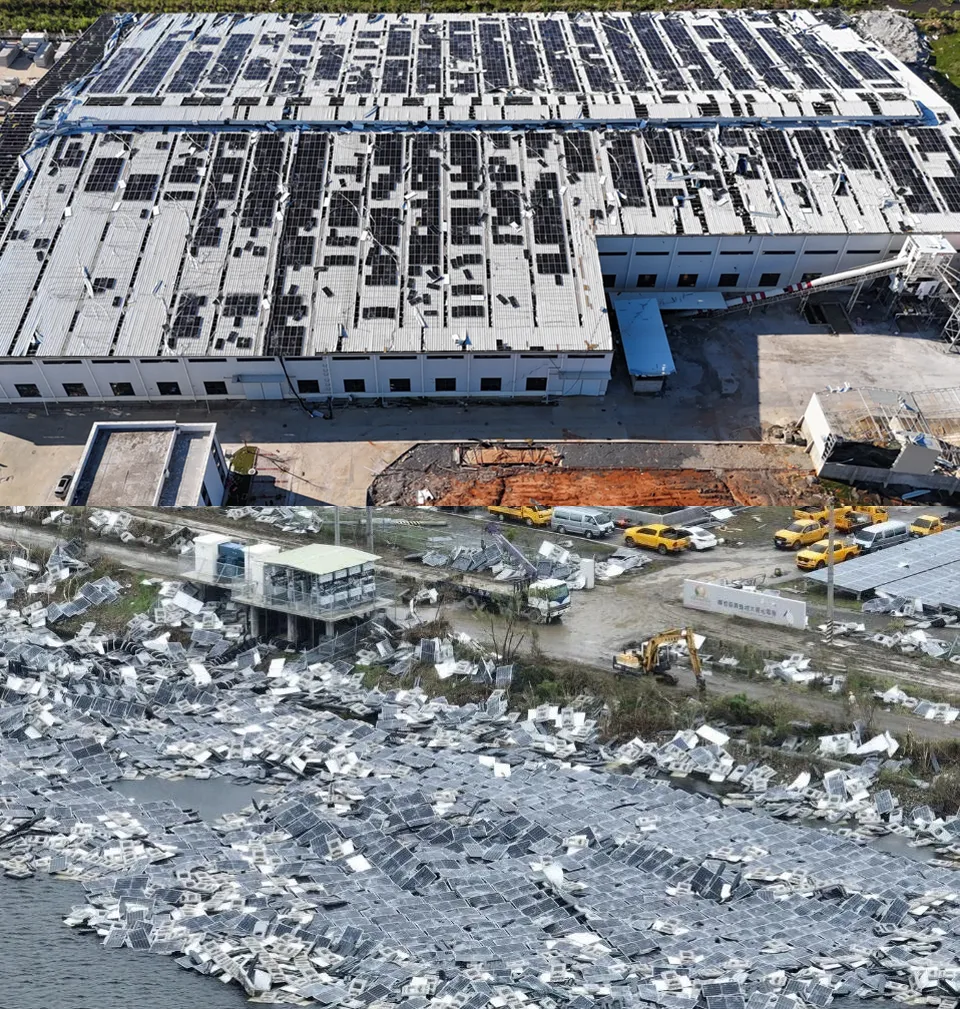
Caption: Standard IEC panels scattered after a storm vs. a structurally reinforced system.
Hail Impact Classification: Baseline vs. Class 4 Resilience
The threshold for hail protection varies between the basic standard entry points and premium specifications:
The FM 4478 Entry Baseline: The absolute minimum threshold required to pass FM 4478 certification is a Class 2 (31.8 mm / 1.25 in) hail impact rating. Many manufacturers optimize their cost structures by matching this baseline and securing the corresponding test report.
The IEC 61215 Baseline: The standard mechanical impact test utilizes 25 mm (1 in) hailstones traveling at 23 m/s.
HOOGO's Premium Standard: In projects located in severe convective storm corridors, basic thresholds may not suffice for risk mitigation. HOOGO intentionally engineered its system to achieve FM 4478 Class 4 Hail Resistance, surviving 50.8 mm (2-inch) golf-ball-sized impacts at terminal velocities of 55.8 m/s (~32.2 Joules of kinetic energy).
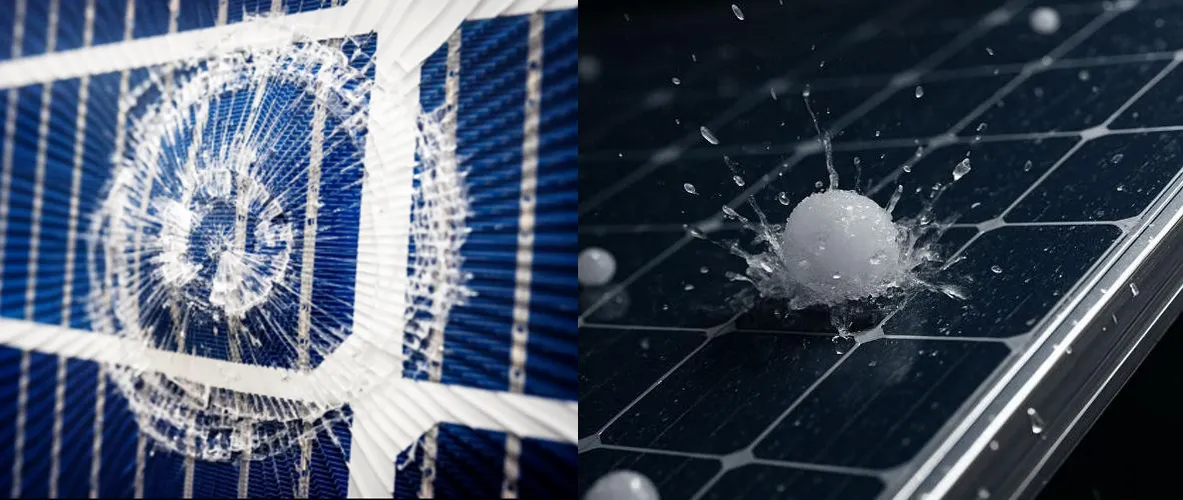
Caption: Hail test comparison chart.
5. Summary: Commercial Alignment with Project Risk Profiles
For global C&I procurement teams, the decision framework is dictated by the asset’s geographic location and insurance underwriting demands:
Standard Asset Compliance: For conventional commercial installations in low-risk zones with standard insurance configurations, verification of IEC 61215 Type Approval Certificates ensures the foundational electrical and component safety required for grid connection.
Insured Asset Maximization: For facilities where the building infrastructure is insured under specialized catastrophic risk frameworks—most notably FM Global insurance projects—compliance with FM 4478 is typically a non-negotiable prerequisite.
By integrating high-durability modules with certified roofing structures like Butler, enterprises do not simply satisfy a product standard; they build a validated, documented system aligned with global property conservation engineering.
Technical Note: HOOGO's FM 4478 Approved configurations are fully backed by certified test reports detailing the specific roof deck, fastener, and bracket combinations tested. For copies of the original compliance reports and wind load calculation metrics, please contact our global engineering support division.
Related Products
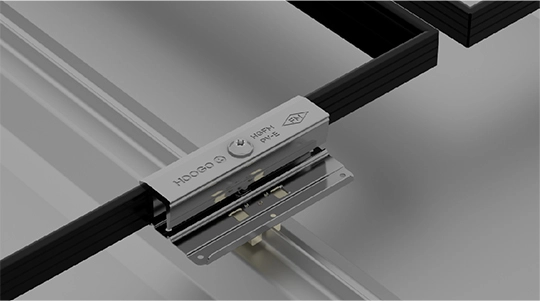
FM Approved Roof-Mounting PV Module Systems
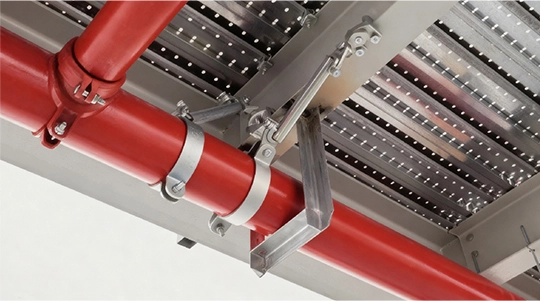
FM Approved Seismic Bracing Systems
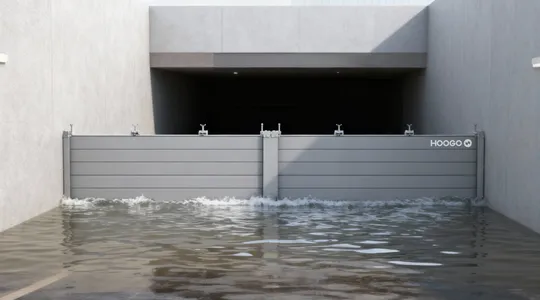
FM Approved Flood Barrier System
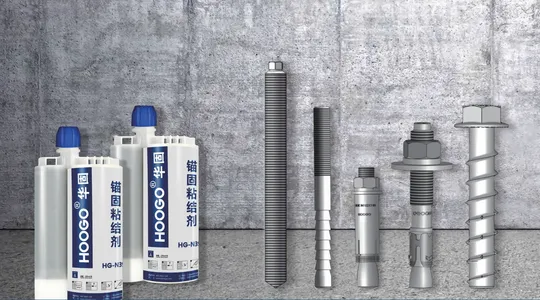
ETA Certified Anchor Fixing System
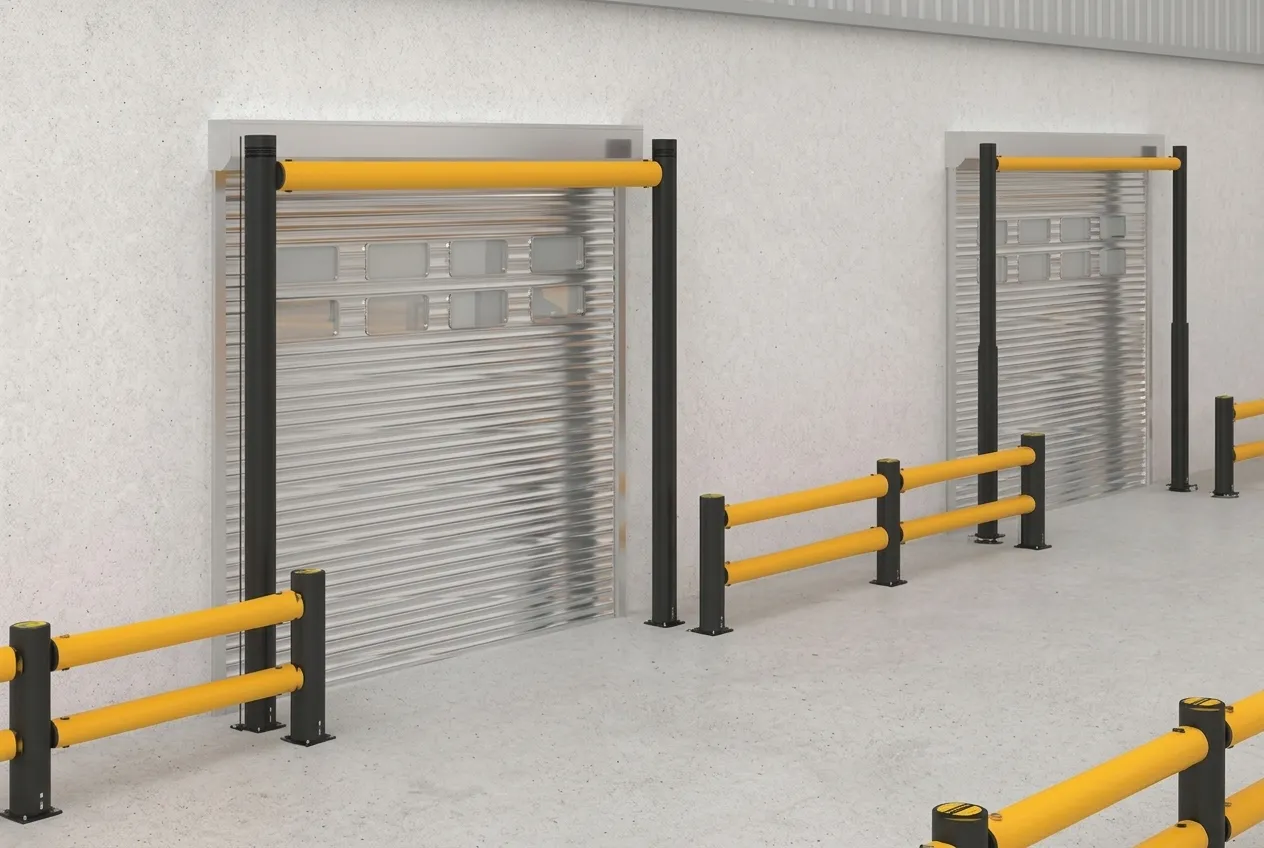
TUV Certified Flexible Barrier System